Thursday, February 22, 2024

Rising from the Grave (briefly)

 I am reminded that this blog still exists every year when my domain registration comes up for renewal. I always renew it because every once in a while a friend will ask me about the historicity of Jesus or the origin of Easter, and it's handy to be able to give them a link instead of repeating myself. (This is the same rationale that has resulted in my keeping a plastic tub of outdated cables, chargers, and extraneous computer giblets, since there was one time I actually needed one of them...) So after nearly a decade of silence, it is past time that I provide an update, explain my absence, and close up shop.

Suffice it to say that I am no longer actively engaged in my former academic pursuits, and that is unlikely to change. But I will leave this site intact as a monument to my past efforts (and perhaps my hubris). Look upon my works ye mighty, and all that.

To the 5-6 people who actually read this thing, thank you for your support. 

Be kind, my friends, for we are fleeting.


Saturday, October 29, 2016

Back in front of the classroom

For almost five years, economic necessity and family responsibilities made it impossible for me to teach, even part time. Long enough that I almost forgot why I wanted to do it. But this semester I got the chance to teach two sections at Mercy College's Bronx campus, and despite typical adjunct pay, a two-hour commute, and a class at 8:30 on Friday morning, I am loving it.

First of all, I quite like Mercy as an organization. They make a real effort to make adjuncts feel like members of the faculty. I mean, we don't get offices or anything, but we were part of the new faculty orientation, we are invited to all faculty events, etc. But more important, Mercy's mission is to provide higher education to underserved groups, particularly women of color, and while its marketing makes the school out to be very practical and career-focused, the truth is they work hard to sneak in a taste of a liberal arts education while preparing students for the job market. Mercy's students are 70% women (mine are more like 85%), and anecdotally, having fewer men seems to dramatically improve to quality and diversity of discourse. I had one section while a TA that was all women, and I think it was the only one I've ever had where everyone participated in discussion. I'm seeing much the same thing at Mercy, where classes are mercifully (heh) small enough to allow for group discussion. (The classes are also 1 day/week for 3 hours, so if I had to lecture the whole time I would pull something.) I don't want to come off like some white savior trope from a bad '80s movie (where I sit backwards on my chair, "get real," and teach them to believe in themselves through study montages and hip-hop dance numbers), but I do feel like I can make more of a difference at Mercy than I could at a school with a more privileged student population.

Anyway, it's also academic job-hunting season, and I've been spending a lot of time writing cover letters and teaching statements, in which I go on about how much I get from my students and what they mean to me, and I realized it was stupid to be saying this to strangers who probably aren't going to hire me anyway, and not directly to my students. So I did just that ("I swear, I'm not drunk...") They were amused, although I don't think it inspired anybody to study any harder for the midterm.

Although truth be told, I do feel a little drunk after teaching. It leaves me with a euphoria that I only otherwise encounter when singing. Maybe I just like an audience, but it genuinely changes how I feel about everything when I have a student tell me how much they love the class, or when I see the lights go on and they make a connection that goes beyond what they've been taught. I can't imagine doing anything else, which means I am kind of doomed. I love teaching too much to hold out for what my intellectual labor is worth, which means I am the perfect prey for the contingent-faculty monster.

My work is done here

The top search term leading to this blog is "drunken Noah." *micdrop*

Thursday, September 1, 2016

Old Punks and Safe Spaces

There has been a lot of back-and-forth lately about “safe spaces” and “trigger warnings” in academia. One side (typified by the recent acceptance letters sent out by the University of Chicago) views safe spaces and trigger warnings (which are distinct but not unrelated practices) as threats to free speech, academic inquiry, and the development of critical thinking in students. (If this sounds familiar, these are much the same terms by which “political correctness” was being attacked when I entered Sarah Lawrence College 25 years ago…) On the other side are those who argue that this caricature misconstrues practices that actually encourage discourse by making the classroom more accessible to all. I tend to side with the latter position, at least in terms of the intent, although I suspect in practice the truth may lie somewhere in between.

But I want to talk about a different kind of safe space, something that has shaped how I conduct my classroom:

The mosh pit.

For those unfamiliar, a mosh pit is a region near the stage at punk shows (originally, at least), where members of the audience dance by colliding into one another, usually in a generally circular flow. (Nobody actually uses the term “slam dance,” but that’s the basic idea.)

How on earth can a bunch of sweaty punks running into each other be considered a “safe space”? Well, while the pit might look like complete chaos from the outside, it isn’t a fight and it isn’t a free-for-all. There are rules (or, at least, there were supposed to be). You don’t go into the pit looking to hurt other people (or yourself). You go in to be part of the community. It is difficult to explain to anyone who hasn’t experienced it, but mosh pits are places of love. Yes, you can get hurt. It isn’t free from danger, but it is (ideally) free of malice. You know you are surrounded by—literally connected to—people who are your friends. That big dude who knocks you over will pull you back up with a smile and hug you, even if he’s never seen you before. If somebody is hurt, or wants out of the pit, a space opens up and they are swept into safety. Nobody is in the pit against their will, and as long as you’re not being a dick, everyone in the pit is looking out for you.

(It is worth noting that while this account of the pit may be colored by many decades of nostalgia, but I briefly threw my middle-aged carcass into the pit at a show last weekend, and the experience was much the same. I hugged more people during two songs than I have in two months.)

And this is how I think classrooms should operate. Education is not without risk. Your ideas will be challenged, your sense of how things are can get knocked around, you will be confronted with things that make you uncomfortable, or angry, or sad. Which is why it needs to happen in an environment where you have zero doubt that you are surrounded by friends. The person who knocks your ideas over should be the first one to help you back up. No student should ever feel attacked, even if they do get metaphorically bruised or battered. That requires trust and loyalty and love. And occasionally a big scary bouncer to step in and make sure one person isn’t ruining everybody else’s fun by ignoring their commitment to the community. 

(Did I mention I used to be a bouncer? To this day, if I stand outside a bar, people try to show me their ID…)


My point is that being safe isn’t about being free from danger. We’re never free from danger. Being safe is about being surrounded by people who care about you as a human being, who are on your side, and who will face the danger with you. In mosh pits, people voluntarily subject themselves to something scary, because when they come out of it (relatively) unscathed, they feel all the safer for the bonds they have forged with those who shared the risk. We can do that intellectually, too.

Saturday, July 9, 2016

Congratulations?

I'm in a ranty mood, but I've promised to give up discussing current politics on the internet until I actually  get off my butt and get involved in positive change.

So instead I'm going to rant about academia.

I have an old friend who recently completed her PhD in archaeology, although I have known her since she was a punk-rock bartender and freelance coder (yes, she's pretty much a William Gibson character). Anyway, she posted on Facebook today that the final version of an article she'd written had been accepted by a journal. I started to congratulate her, but what came out was:

"Congratulations of giving away months of labor to someone who is going to sell it for profit."

Now, this friend knows me well enough to get the dark humor, but also to appreciate the truth. Like so much of academia, the academic publishing system is based around a model that simply doesn't exist anymore. If every scholar had a TT position with a reasonable class load, summers off, and periodic paid research sabbaticals, it would be fair to say that their universities are paying them for their research. Publishing their research is just a job requirement, at least if they expect to get tenure. Academic publishers are just sort of secondary beneficiaries of the process. And, of course, they benefit on both ends, and the universities are also their primary customers. Even a large portion of their editorial process (peer review, etc.) is done on a voluntary basis. All part of our service to the discipline.

But the above scenario does not describe the reality of many scholars, especially in their early careers. Even if they are lucky enough to have full time positions, they may be carrying 4/4 (or higher!) class loads. Between budget cuts and the ultra-competitive market, scholars often have little choice but to accept positions that provide little time for research and writing. And as for adjuncts! There's no need to repeat what has been said too many times, but adjuncts are explicitly paid just for the "contact hours" they spend teaching. Perhaps an extra 10 minutes per hour for prep, but research isn't even on the menu, especially given the number of "contact hours" one has to be working to survive.

Yet at the same time, it is these early-career scholars who are in the most desperate need of being published. They need to be able to demonstrate an active research agenda to compete with the hundreds of other CVs inundating search committees. I have no idea if there are statistics on the career-stage of journal authors, but it seems to me that, much as the glut of scholars enables the adjunct system, it also provides academic publishers with a tremendous amount of free content whose creators' only compensation is the hope that another line on their CV will increase their chances at a job.

I know a few professional artists and musicians, by which I mean people who actually pay their bills with art and music. And they invariably get people who ask them to produce or perform for free, on the grounds that it's "good exposure." And these artists and musicians react with scorn, because they are professionals, and professionals get paid. Their joke is "You can't eat exposure. People die of exposure." Given the realities of the academic job market, academic publishers are asking independent scholars, adjuncts, and those in teaching-heavy positions to give away their labor for free, and pay their rent with hope and a line on their CV.

I am not under the illusion that journal publishers are in it for the fast cash. This isn't the music business or paperback fiction. The academic market is limited, their publishing cycle involves a lot more work than conventional publications, and the internet is disrupting their paradigm all over the place. Some publishers are non-profit or operated by universities, but a quick web search finds Sage Publications reporting roughly £200m in profits after taxes in 2015. I'm sure only a fraction of that comes from the sale of unpaid journal articles (I'll see if the report gives any indication when my kittens stop attacking the screen), but I doubt their losing money on the deal. I know they are one of the publishers who lets authors pay for the "privilege" of allowing open access to their work, which seems an awful lot like having your boss tell you to pay your own wages. Other journals, of course, are truly open access, relying on grants or government funds or profits from elsewhere to cover the costs of publishing research. Which may be grand, to the extent that it means someone else isn't profiting from scholars' unpaid labor. But it don't pay the rental, as the song goes.

I don't think it's realistic to assume we are ever going to return to the days where full-time, tenured or tenure-track professional scholars were the norm. Full-time professional anythings seem to be dwindling away. If anything, we are going to keep moving further into an Uber-ized, employee-free, work-for-hire, freelance economy. (A model which non-academic publishing has survived on for decades.) If the majority of scholars are not going to the salaried employees of universities, paid both for teaching and research, but ad-hoc contractors hired only to teach, then academic publishers are going to either have to find a way to compensate scholars who create the content they sell, or stop publishing journals altogether. In the latter case, open-access electronic publications--with much lower overhead than print--might be able to take up the slack in terms of getting the research out into the world, but the research will never happen if scholars' only income derives from teaching hours.

We have already seen some scholarly societies setting sliding scales for membership and conference costs for contingent faculty and unaffiliated scholars. Perhaps such an arrangement can work for publishers as well. Scholars with full-time posts would continue to work for free, while the unaffiliated, grad students, etc. would be paid at a per-word rate comparable to mainstream publishing. Or pay the authors royalties based on sales/subscriptions/downloads as they already do with books. Self-publishing and self-distribution make less viable an options for academia than they are for other content creation simply because of the need for peer review and oversight, but there are already experiments in open-access peer-review out there that could be adapted, if there was a will to do so within the academy.

My point, I guess, is that it isn't out of line for people with advanced qualifications and expertise to expect to be paid for their labor. Or, at least, to decide if they want to give it away. (At $.05/word, somebody might have paid me $50 for this rant...) Nobody goes into academia for the money, but both universities and publishers have taken advantage of our idealism (and obsessive tendencies) to convince us to work for far less than what our work is actually worth to them. Even in a highly-competitive labor market, we have the power to force more equitable conditions, if we are unified in our goals. (Did I mention my grandfather organized for United Mine Workers?) I want to educate people. I want to contribute to the sum of human knowledge. I want to cultivate the next generation of scholars. But I also want to eat and keep a roof over my head. We create content, whether it is in the classroom or on the pages of a journal, that people are willing to pay for. We have the right to be paid for that.

Monday, June 20, 2016

Oh dear.

So, I have been grossly negligent of this blog, and I'm sorry. Suffice it to say that the past two years have been really brutal, but I am finally getting back to a reasonable level of productivity, and I hope to have some proper content in the near future.

In the mean time, it looks like the "Gospel of Jesus' Wife" has officially blown up, which comes a shock to exactly no-one who was following the story closely. What's interesting about the story to me is not that it was a forgery, but that the forgery was detected through various blogs and online discussions long before the slow-turning wheels of academic publication and traditional peer review were able to process it. This is in part the result of the existence of the fragment being announced to the mainstream press years before Karen King's HTL article would see print.

Which, I guess, is how scholarship gets done these days. There is a such a pressure to come up with something sensational enough to grab the general public's attention that even excellent scholars like Dr. King can jump the gun.

I recently had the experience of having an academic publisher tell me that my research was too "arcane" to be "economically viable." I was recounting this experience to some random guy during karaoke at my favorite Doctor Who-themed bar last night, and his response was "Well, why don't you research something more economically viable?" And this case is a good example of why not: when you take your eyes off the goal of honest, critical scholarship and start worrying about selling books or pulling in grants or boosting the prestige of your department, there will always be a temptation to turn a blind eye to anything that might get in the way of the narrative you're trying to sell.

But what do I know? All the self-righteous integrity in the world won't benefit me or the discipline if my stuff is never published.

Sunday, June 14, 2015

The Supernatural Cinema of Guillermo del Toro: Critical Essays, featuring my chapter, "The Birth of Fantasy: A Nietzschean Reading of Pan's Labyrinth," is now available. Because I do philosophy sometimes.

Monday, January 19, 2015

The Search for the Historical MLK

Just like clockwork, conservatives inevitably celebrate Martin Luther King Day by attempting to claim him as one of their own. (The first Google hit this year comes from Sarah Palin, who asks on her Facebook that the President stop "playing the race card" in honor of Dr. King.)

The naive argument, coming from conservatives who have never bothered to read anything Dr. King wrote beyond a few quotes from a single speech, is that since King wanted people to be judged by the "content of their character," he must have been calling for a race-blind society free of government interference based on race or economic status.

This is, of course, complete bullshit. King was a radical. He considered unfettered capitalism to be a great evil, and his primary critique of communism was over its atheism, and its subjection of the individual to the state, not with its goal of redistribution of wealth. The full name of the historic 1963 march was "The March on Washington for Jobs and Freedom." King supported ideas like universal healthcare, affirmative action, and GI-Bill style federal programs designed specifically to provide jobs and education for black people. Conservatives mistake his pacifism for passivism, but King was not a gradualist. He didn't couch his calls for justice in terms designed to make white people comfortable; he was calling for a complete disruption of the existing, unjust order.

(If I took the time to cite evidence for these claims, I'd never get this posted, but all of these ideas are easily found in his accessible books Strength to Love and Why We Can't Wait.)

I bring this up because it is illustrative to see how, in less than 50 years, the message of an historical figure--even one who wrote lucidly and prolifically--can be distorted by the mechanisms of social memory. By elevating him to the position of a secular saint, we have in many ways defused the very things that made him dangerous. We remember that he was a man of peace, but we forget that he was using peace to fight a war that is still not won. His message was not "Can't we all just get along?" but "We refuse to 'get along' with a system of violent injustice!" I think this is pertinent to biblical studies exactly because the radical message of Jesus--as near as we can reconstruct it--has been re-written time and again by similar processes.

(This isn't just a conservative problem, BTW. Liberals [particularly white ones] are guilty of sanding down the rough edges of King's message as well, perhaps in an attempt to legitimize the middling, snails-pace gradualism that has come to characterize the Democrats' approaches to racial and economic justice. And there is also a tendency on the left to minimize the centrality of Christianity to King's activism. To be sure, there were plenty of people in the Civil Rights Movement who dedicated themselves to fighting for equality for non-religious reasons, but you can't understand Martin Luther King without understanding ideas like agape, redemptive suffering, and the immortality of the soul.)

Friday, November 21, 2014

SBL/AAR Preliminary Report

Notes so far:

The OTHER John J. Collins was on my flight out of Dulles. He seemed rather bemused when I introduced myself.

Larry Hartudo was on my shuttle from the airport, where I also met Frances Flannery from JMU, who has apparently managed to leverage her expertise in apocalyptic into a side-line in counter-terrorism. So much for my insistence that what I do had no practical applications.

The Hard Rock Hotel is just cheesy enough to enjoy ironically. The rest of the Gaslight District is a little TO cheesy. But that would be like judging Baltimore by the Inner Harbor, so I won't hold it against San Diego.

I think part of the reason I have so much trouble socializing at these things it's I can't tell the guys apart. Skinny white dudes with receding hairline, scruffy beards, black-framed glasses and tweed blazers.

Or maybe those were hipsters.

Regardless, would it hurt to get something pieced or tattooed so I can tell you guys apart? (Oh, yeah, I guess it would...) I'm missing my accustomed cultural cues.

Monday, November 17, 2014

SBL Presentations

Here are the papers I will be presenting at the SBL Annual Meeting in San Diego this weekend. Please drop in if you're interested; there's nothing sadder than playing to an empty room. Or feel free to come up and say hi if you see me. I'll be the one in black with bright red hair.

Function of Apocryphal and Pseudepigraphal Writings in Early Judaism and Early Christianity
Saturday, 11/22/2014
4:00 PM to 6:30 PM
Room: 400 A (Level 4 (Sapphire)) - Hilton Bayfront (HB)
"Degraded from Their Heavenly Vigour": Fallen Angels, the Testament of Solomon, and the Demonology of the Early African Church (5:00-5:30pm)
The works of the third century Latin fathers Tertullian (Apology), Minucius Felix (Octavius), Cyprian (On the Vanity of Idols), and Lactantius (Divine Institutes) contain strikingly similar (often verbatim) accounts of the origin and nature of demons. Direct dependence between some of the sources is possible, but the overall trajectory of any influence is obscure—particularly given the uncertain dates of Felix—and to date, no scholars have undertaken to clarify the relationship. The demonology presented by these African sources draws heavily on Justin Martyr, and upon especially Athenagoras, with whom they agree in distinguishing fallen angels from demons, the latter being the spirits of the children born to fallen angels and human women. 
This paper will trace this concept of demons from its origins in 1 Enoch 15–16 and Jubilees 10, through Justin and Athenagoras, and then compare it to the demonology evident in the Testament of Solomon. This will firmly locate T. Sol. within the context of third-century Christian thought, reflecting a specific sub-stratum of the Enochic fallen-angel complex in which the giants—rather than the angels themselves—were seen as the primary tradents in forbidden heavenly knowledge. Finally, a synopsis of the relevant passages will demonstrate that the commonalities and divergences of the African authors are better explained by a shared, external Latin source than by any direct dependence between them, or by the shared influence of the Greek text of Athenagoras. This study will enrich our understanding of the vital role that demonological concerns played in the worldview of the early fathers, and how these concerns shaped—and were shaped by—pseudepigraphal works.
(NOTE: This paper has evolved significantly since I wrote the proposal.)

Pseudepigrapha
Sunday, 11/23/2014
1:00 PM to 3:30 PM
Room: 411 A (Level 4 (Sapphire)) - Hilton Bayfront (HB) 
Angels, Giants, and Culture Heroes in the Development and Reception of the Book of the Watchers (1:30-2:00pm)
The `Asa'el or instruction narrative in the Book of the Watchers (roughly, 1 Enoch 7:1; 8:1–3; 9:6, 8; 10:4–8) presents distinct interpretive and historical challenges in its decidedly negative reappropriation of a usually positive ancient literary motif, viz., that of supernatural culture heroes who provide humanity with essential knowledge or technology. This motif of angelic instruction figures prominently in the later reception of the BW narrative, but many of these interpretations seem to retain vestiges of more positive culture-hero traditions associated giants and with the flood. Through a diachronic survey of several key texts, this paper will demonstrate the influence of other, more positive culture-hero traditions, rooted in Gen 6:1–4, which were not derived from the negative portrayal of angelic instruction found in the Book of the Watchers. 
By proposing set of criteria for determining the presence of these parallel traditions, I will argue that two additional, independent complexes of tradition played a key part in Jewish and Christian interpretations of the fallen-angel myth, and contributed to some of the less negative portrayals of angelic instruction found therein. In the first of these traditions, Noah and members of his family are depicted as giants, or as the offspring of angels, and are said to be responsible for the transmission of secret, antediluvian knowledge. John C. Reeves (1993) already identified traces of these traditions in ancient birth-narratives of Noah and in the pseudo-Eupolemus fragments, but they are also evident in later traditions attributing the origins of alchemy to Ham. The other complex concerns the fallen angels’ failed divine commission as the keepers of the cosmic order. This narrative (attested in Jubilees and the “Animal Apocalypse” [1 En. 85–90]) differs from the Book of the Watchers in depicting a two-stage fall, in which the angels’ presence on earth leads them to sin, thus shifting the vector of corruption. Connected with this strand in particular are traditions associating the fallen angels with the celestial spheres (not simply the interpretation thereof), and those treating the fallen angels or the spirits of the giants as objects of human worship. 
The presence of parallel fallen-angel traditions has several important implications to the study of Enochic literature. First, it would solve the long-standing question of why the culture-hero stratum was inserted into the Book of the Watchers at all, by demonstrating that the motifs of culture heroes, the flood, and giants were readily associated in the contemporary cultural lexicon. Instead of an intrusion, the `Asa'el narrative becomes an organic extension of the themes of the book. Moreover, parallel fallen-angel traditions would also explain why motifs not attested in the Book of the Watchers appear independently in later interpretations of the Watchers myth. As certain themes and motifs became entangled in the traditions derived from 1 Enoch, the interpretive “canon” expanded beyond the text itself to include certain implicit connections drawn from outside traditions.
(NOTE: Redacted text corresponds to a section of the paper cut for time.)

Tuesday, November 11, 2014

Neither this nor that

Many years ago, there was a Life in Hell cartoon called "Fun Science Facts," which proclaimed "Ringworm is neither ring nor is it a worm. It is a fungus," followed by, "Fishsticks are neither fish nor are they sticks. They are a fungus."

Well, as expected, Simcha Jacobovici's The Lost Gospel: Decoding the Ancient Text that Reveals Jesus’ Marriage to Mary the Magdalene is neither lost, nor a gospel, nor is it about Jesus and Mary Magdalene. 

It is a fungus.

(It isn't even decoded. The only accurate words in the title are "ancient text.")

Saturday, October 18, 2014

Addendum

Some months ago, in my review of the movie Noah, I said I was aware of no direct antecedent to the film's portrayal of the fallen angels' transformation into stone after the fall. While I was going over some primary sources for an upcoming paper, I realized I had forgotten something.

The Pseudo-Clementine Homilies, a Christian work (possibly Jewish-Christian) originating before the 4th century CE, contains a version of the fallen-angels narrative in which the angels transform themselves into precious stones!

For of the spirits who inhabit the heaven, the angels who dwell in the lowest region, being grieved at the ingratitude of men to God, asked that they might come into the life of men, that, really becoming men, by more intercourse they might convict those who had acted ungratefully towards Him, and might subject every one to adequate punishment. When, therefore, their petition was granted, they metamorphosed themselves into every nature… So they became precious stones, and goodly pearl, and the most beauteous purple, and choice gold, and all matter that is held in most esteem. And they fell into the hands of some, and into the bosoms of others, and suffered themselves to be stolen by them. (Hom. 8:12–13, trans. ANF 8:272–274)
In this version of the story, the angels descend to test the righteousness of humanity, and their transformation is a voluntary one. The precious stones, gold, and purple fabric are clearly an allusion to 1 Enoch 8:1-2, wherein the Watchers teach humanity how to fashion dyes, jewelry, and cosmetics, which in turn lead to greater human wickedness, although the emphasis in the Homilies is more on greed than the temptation of female adornments implicit in 1 Enoch. In the Homilies the angels themselves are not corrupted until they later transform into human form, and take on the concomitant weaknesses and lusts.

I have no idea if Aronofsky might have had this story in mind when he imagined his stone Watchers. Most of his sources seem to have been Jewish, not Christian (and most can be found in Ginzburg's Legends of the Jews,) so I'd guess not, but it's such a strange and delightful variation on the Watchers tradition that I can't believe I didn't think to include it in my original review.

Monday, May 26, 2014

NAPS wrapup (NAPup?)

Had a lovely time in Chicago at the North American Patristics Society conference last week. Response to my paper on Enochic motifs in the Mar Saba Letter was generally positive, which was almost disappointing, since I was hoping to stir up some controversy. I met all sorts of nice and brilliant people whose names I promptly forgot because I'm a goon. But that's what business cards are for. (Special thanks to the fellow who very kindly offered me a seat at his table at the banquet when he saw me wandering with my plate like a nerdy kid in the high school cafeteria.)

Also, I may be falling in love with Chicago. Karaoke at the Blue Frog!

Tuesday, May 6, 2014

Be Careful What You Wish For

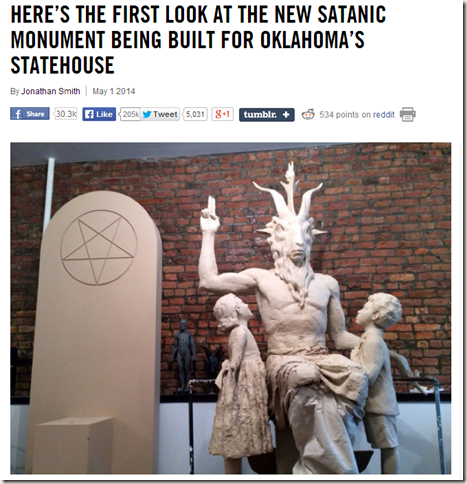
The SCOTUS has ruled to allow government meetings to include prayers, even if those prayers are exclusive to a specific religion. I do actually agree with Justice Kennedy that any attempt to craft a non-sectarian prayer would involve an unacceptable level of government interference in religion. But the answer is to avoid public prayers at government meetings altogether, not to allow sectarian prayers. In a religiously pluralistic society, any sectarian prayer is going to exclude someone. And if you try to include everyone, you get Baphomets.

image

I’m strongly of the opinion that intermingling religion and government is as harmful to religion as it is to government. Those who push for more religion in government are in for a nasty surprise if we end up like Denmark, where 78% of people are members of the state church, but only 28% of people believe in God. As silly as the Oklahoma City “Satanic monument” is (and the Satanists know they are being silly), it makes an important point: when you give religion the force of being “official,” you can’t guarantee it will always be your religion. Before involving the government in religion, ask yourself, WWALVD? What would Anton LaVey do, if his religion had this official sanction? If you don’t like the answer, it’s probably not worth it.

Monday, May 5, 2014

Noah: Hollywood Midrash

I would like to apologize to the five or six people who actually read this blog for my long silence. This year required me to devote almost all of my energies to more immediate priorities. My updates will be infrequent for the foreseeable future, but I have not abandoned this project. This particular entry is a few months too late to be of any relevance, and bordering on TLDR, but I promised a few people I would write it. I will come back later and markup the text with citations for the specific primary sources I mention below.

It isn’t very often that my obscure specialty—Jewish and Christian traditions about fallen angels—receives much popular attention, so Darren Aronofsky’s Noah presents a rare opportunity for me to geek out to the public at large. I’m not particularly interested in the controversy surrounding the movie, but rather how Aronofsky made use of a wide variety of ancient extra-biblical traditions associated with the Noah story in crafting his film.


Sources

The biblical story of Noah, found in Genesis 6:7–9:29, would make a very short movie. The sparse (and sometimes contradictory) nature of the narrative led Jews and Christians over the centuries to expand upon the story and fill in the gaps. Many of these traditions have been preserved in the “Old Testament Pseudepigrapha” (ancient Jewish and Christian writings that usually claim to be written by biblical figures), in Jewish midrash (rabbinic commentaries on the biblical text), and a variety of other religious and historical sources.


The Watchers

Perhaps the most startling addition Aronofsky makes to the Noah story is the inclusion of the Watchers, who are explained in the film’s prologue to be angels who descended to earth to alleviate humanity’s suffering, only to be transformed into giant stone monsters resembling Rock Biter from the Neverending Story.

these hands... they look like such big good strong hands - these hands... they look like such big good strong hands  Rockbiter

The story of the Watchers is derived from the preface to the flood story in Gen 6:1-4. These verses tell of “sons of God” who married “daughters of men” and fathered children who are called Gibborim (“mighty ones” or “heroes”) and Nephilim (“fallen ones”?) in Hebrew. The earliest Jewish interpretations of this verse understand the “sons of God” to be angels, and the Gibborim and Nephilim to be half-human, half-angel giants. The most detailed early version of this story comes from the Book of the Watchers, written around 250 BC, which is part of the larger Book of Enoch. The Book of Enoch was considered authoritative by many early Christians (it is even quoted in the New Testament), and remains part of the Bible of the Ethiopian Orthodox Church.

According to Enoch, the Watchers taught humanity a number of skills, including astrology, metal-working, and the use of herbs for medicine. This forbidden knowledge then leads humanity to sin and violence. In the film, the Watchers are portrayed as aiding humanity (first willingly, then as slaves) in constructing cities and building the industry that despoils the earth. But Aronofsky’s Watchers are much more sympathetic than they are in Enoch. They descend to earth to help humanity (an idea also found in the second century BC Book of Jubilees), and there is no hint of sexual impropriety. The Watchers themselves, not their children, are portrayed as giants. (Confusion between the fallen angels and the giant nephilim can be found in ancient sources as well.)

Most notably, in Enoch, the Watchers are bound in chains by the Archangels for their disobedience, but it is humans who enslave them in the movie. The film’s Watchers become more like the Greek Prometheus, who suffered for giving the gift of fire to help humanity. And while most Jewish and Christian portrayals are negative, there are a few hints in ancient sources for traditions in which the fallen angels and giants were seen as positive teachers—maybe even a story in which Noah is one of the giants!

The most prominent Watcher in the film is called Og. In the Bible, Og is the king of Bashan who fights against Moses during the Exodus. Og is said to be the last of a race of giants called Rephaim. Since Enoch and other traditions generally say that all of the giants died in the flood, the survival of Og is the subject of speculation in Jewish legends. In one version, he survives by clinging to the outside of the ark. The Babylonian Talmud identifies him as the grandson of the fallen angel Shemhazai.

Shemhazai appears in the film as Samyaza (the Ethiopic spelling of the name). In Enoch, he is the ring-leader who convinces the other angels to descend to earth. His punishment for this is to be bound by the archangel Michael beneath the earth until the final judgment. In one medieval midrash, however, he repents and is snatched up into the sky as a constellation. This is clearly the inspiration for the scene in which the Samyaza (and then the other Watchers) ask for forgiveness and ascend in their luminous forms. It is implied that they return to heaven, but in the midrash, Shemhazai spends eternity stuck halfway between.

One interesting addition Aronofsky makes to the story of the fallen angels is their transformation into living stone after they fall. I am unaware of any specific antecedent to this, but several medieval Jewish versions of the fallen angel myth state that when they fell, the angels gave up their spiritual forms and took on earthly bodies (this was to avoid the problematic issue of angels mating with humans). But I have to wonder if the stone giants might not be an allusion to the fossilized bones of dinosaurs. Numerous ancient sources report witnessing the bones of primordial giants, and some have speculated that these may have been the remains of prehistoric animals. Perhaps this was meant as a subtle jab at young-earth creationists, for whom fossils pose a particular difficulty.


Noah is Kind of a Dick

The film’s portrayal of Noah as a tortured, morally-ambiguous figure may be jarring to modern audiences. Much of the film’s tension is built around the audience’s own doubts about Noah’s sanity. God does not address Noah in words the way he does in the biblical version. Instead, Noah experiences a series of visions. This places him more in the tradition of apocalyptic visionaries like Daniel and John of Patmos (traditional author of the Book of Revelation), but without an angel to interpret the visions. (Methuselah arguably takes on the role of angelus interpres.) So we are never 100% sure he understands God’s will, creating a powerful warning about the dangers of absolute faith.

But negative or equivocal portrayals of Noah are attested in earlier sources as well. Midrashic commentators note that scripture says Noah was blameless “in his generation.” Given the rabbinic assumption that the Torah doesn’t waste words, this implies that Noah’s righteousness was relative to the wickedest generation in history. The story of his naked drinking binge is entirely biblical, after all (Gen. 9:20-27), so a little suspicion was justified. In one story, he keeps doubting God right up until the water was up to his knees. In another, the reason the raven doesn’t return with news of land is because Noah was mean to it on the ark.


The notion that the animals were saved because they were innocent isn’t consistent with most interpretations. The Book of Jubilees makes it explicit that all flesh, even animals, were despoiled by the sins of humanity and the giants. Indeed, the idea that God would punish innocent animals for human sin was as troubling to writers of the past as it is to modern readers. Their solution was that the animals weren’t innocent, with one midrash explaining that animals started mating indiscriminately across species in imitation of humanity. The pairs (or sevens) of animals that were saved were the righteous among their kind!

And while I am aware of a few midrashim in which God didn’t intend to save anyone from the flood until Noah’s virtue convinced him otherwise, Noah’s declaration in the film that all humans, even his own family, were so innately tainted that they had to die, well, it struck me as remarkably…Christian—even Calvinist—for a movie by a Jewish director based on Jewish traditions.


Mrs. Noah


Like Bill and Ted, many ancient writers wondered about the details of Noah’s wife, who is mentioned only in passing by Genesis. The film calls her Naameh, one of numerous names given to her in later traditions (one scholar counts 103). In the Bible, Naameh or Naamah is a descendent of Cain, and sister to Tubal-Cain, but the Rabbis disagree as to whether this is the same Naamah who married Noah. In some traditions, Naamah the Cainite was the very woman whose beauty caused the angels to fall, or even a demonic succubus. And while the film’s Naameh is shown as faithful and supportive, in other sources (including the Quran), his wife is often portrayed as unfaithful or selfish. In one version, she even sets the ark on fire!


Tubal-Cain

The main heavy in the film is Tubal-Cain, who in the Bible is the descendant of Cain and the first person to forge iron (a skill he displays on screen). Numerous traditions sprung up around him, mostly bad, including some that place him in opposition to Noah before the flood. I am unaware of any stories in which he stows away on the ark (that was Og’s trick), but for the survival of the Cainite line, see my discussion of Ham below.


The Flood

The movie’s depiction of the flood picks and chooses from the details in Genesis. The waters rising up from the ground as well as falling from the sky is entirely in keeping with “the fountains of the great deep” bursting forth in the biblical text, and with the ancient belief that the earth rested atop a watery abyss.


Methuselah

Methuselah, grandfather of Noah, was portrayed delightfully by Anthony Hopkins. In the film, Noah seeks out his grandfather on a distant mountain to explain his visions. This recalls a story found in a later section of the Book of Enoch, in which Noah seeks out not Methuselah, but his father, Enoch (who had been “taken” by God in Gen 5:24), at the ends of the earth, in order to understand his visions of the coming cataclysm.

Methuselah’s contented demise before the floodwaters (having finally found some berries) is also consistent with the Bible, which places Methuselah’s death at the same year as the flood. (At least, the standard Hebrew text does. The numbers in the Greek translation would have him surviving long after the flood.)

But the best moment in the movie is Methuselah’s bemusement at Noah’s vision of a flood:

“Water? Huh. My father said there would be fire.”

I laughed so loud the rest of the audience thought I was nuts.

Because, you see, Methuselah’s father, Enoch, did say there would be fire, but as a punishment for the fallen angels, not humanity.

I like movies with jokes just for me.


Ham


The film gives Noah’s son Ham a hard time, but so does the continuing tradition. The film leaves out the “Curse of Ham” (quite wisely, in my view, given its shameful legacy) that Noah lays upon Ham’s son, Canaan, after the incident with Noah’s drunken nudity. This bizarre bit of the Biblical narrative was as perplexing to readers of the past as it is today. Conjecture about Ham’s exact transgression against his father range from disrespect to rape to incestuous adultery to castration, but all of them leave Ham looking like a bad seed. Rabbinic traditions suggest he and his wife were the only ones to have sex on the ark, while medieval Kabbalistic writings claim he was descended from the demon Samael by way of Cain. And some Christian “Gnostics” said he was the son of a fallen angel, not Noah. So his film portrayal as a horny, petulant middle child is generous, all things considered.


Zohar

Noah prominently features a glowing mineral called “zohar,” basically a cross between Unobtanium and yellow Kryptonite, that is used to power technology, start fires, etc. In Hebrew, zohar means “radiance,” and it is the title of the primary text of the Jewish mystical tradition known as Kabbalah. Aronovsky’s familiarity with Kabbalah is evinced in his1998 movie Pi, but the connection to the obvious fossil-fuel-allegory in the film is obscure.

The mining of metals is one of the skills taught by the Watchers to humanity, and in the film, it is implied that antediluvian society disintegrated once most of the available zohar had been strip-mined. It is curious that the glow of zohar is almost identical to the glow within the rock-monster Watchers. One might even wonder if zohar is mined from dead watchers (extending the fossil metaphor even further), converting their luminous bodies into fuel.

A possible connection between zohar and the Zohar comes in the vision of creation in the movie. While the narration paraphrases the opening verses of Genesis, we see on-screen a stylized representation of evolution from single cells to apes. (Young-earth creationists may want to cover their eyes during this part.) We then see Adam and Eve in Eden, depicted as humanoid figures with glowing bodies. Glowing with the same radiance as zohar. Now, in the Zohar (and numerous other sources, ranging from the Hellenistic Jewish philosopher Philo to Christian apocrypha), when Adam and Eve were first created, they were radiant beings, and it was only after the Fall that they lost this divine radiance. So it may be that the zohar in the movie is either the lost radiance of Adam, which his descendants waste, or possibly the divine radiance of the earth itself.


Meat and Technology

The film’s antediluvian world resembles a Mad Max post-industrial wasteland. Aronofsky makes an interesting move in portraying the pre-flood world as having a level of technology comparable, or even superior, to ours, at least before its collapse. The biblical text does credit Cain with founding the first city, and the continuing tradition makes much of the association between the Cainites and the evils of city life. In the Enochic literature, the technological knowledge provided by the Watchers is one of the causes of the corruption of the earth, so associating technology with sin is a logical extension of the theme. Some sources, like the Book of Jubilees, make it clear that the very earth itself became corrupt, which seems like a fair metaphor for pollution.

Some may be surprised by the depiction of Noah and his family as hippie vegetarians, but that is one of the most explicitly biblical details of the story. In Eden, Adam and Eve are only given permission to eat plants (Gen. 1:29-30), and it isn’t until after the flood that God extends this permission to eating animals (Gen. 9:1-5). With one caveat: they are not to eat meat with the blood still in it. In Judaism, the prohibition of eating meat with blood in it is considered one of the seven “Noahide laws” that apply to all humanity, not just humans. (Others include prohibiting murder, theft, and idolatry.)

It is thus very in keeping with the interpretive tradition that the film portrays the Cainites not only as eating meat, but as tearing the limbs from living animals. That’s just not kosher. In the Pseudo-Clementine Homilies, the giants are the first to eat meat, and their desire for blood leads them to cannibalism (both of humans and one another). Noah’s visions of blood flooding from the Cainite camps recalls Jubilees, where the vast quantity of blood shed by the giants poisons the earth.
I also think it was brilliant to have Tubal-Cain secretly eating animals on the ark. The real cause of extinction was tasting good!

But sadly, I can find no literary precedent for the hyenadillo/armadingo that was being hunted in the beginning of the movie.


Herbs

We first encounter Noah in the film when he is out gathering herbs. Throughout the movie, Noah and his family demonstrate an advanced knowledge of medicinal herbs, including an herbal pregnancy test, not to mention their utterly ingenious solution to the logistical problems of the ark: put all the animals to sleep. Knowledge of herbs was one of the forbidden secrets taught to humanity by the watchers in Enoch. In Jubilees, however, the archangel Raphael teaches Noah how to use plants as medicine (after the flood), in order to protect the survivors from the diseases caused by the demonic spirits of the dead giants. The association between Noah and medicine endured, and several Jewish medical texts from late antiquity claim to be based on the angelic teachings given to Noah.


Stars

A unique feature of Aronovsky’s vision of the world of Noah is that the stars are visible during the daytime. Personally, I choose to see it as a jab at Russell Crowe’s awful rendition of the song “Stars” in Les Misérables. It could also be a nod to inflationary cosmology and the metric expansion of space, in which all stars are accelerating away from each other, and a young universe would have been much smaller. But there are precedents for the idea that the flood also affected the configuration of the stars. The Watchers themselves are often identified with fallen stars or “wandering” planets. Several midrashim speculate that certain constellations resulted from events surrounding the flood. Regardless, I think it adds a marvelous mythic quality to the film, making it clear that its world isn’t the one we live in today.


Ages

Beyond these additions, there are a few places where the film does directly contradict the biblical narrative. One of these is the problematic longevity of the antediluvian patriarchs. The Bible says Noah was 600 at the time of the flood, and lived until he was 950. The ages of his sons Shem, Ham, and Japheth are less clear, since the text only states that they were born after Noah turned 500, but they could have been as old as 100 at the time of the flood. Regardless, in the biblical narrative, all three sons are adults with wives. This would have dissolved one of the main sources of narrative tension in the film, and given the difficulty modern audiences would have with the idea of 500-year-old characters, it seems like a fair compromise. Likewise, having Noah witness his father’s death (Batman style) as a child generates much more pathos than having Lamech die when Noah is 595.
There is no mention of the birth of Shem’s twin daughters in the Bible (Shem’s first son is born two years after the flood), but the Bible seldom mentions the birth of daughters anyway. While the Bible doesn’t specify, Canaan, the son of Ham, seems to have been born before or shortly after the flood, because, as we have seen, he is around to be cursed on his father’s behalf.


Snakeskin Tefillin

I know of no ancient precedent for the ritual involving the shed skin of the serpent, but the way the skin was bound around the arm is an obvious allusion to tefillin, small containers holding verses from the Torah that some Jews strap to their head and arms during prayer. Tefillin, which also figure prominently in Pi, are traditionally associated with remembrance of the Exodus (Ex. 13:9, 16; Deu. 6:9, 11:18), so what connection Aronovsky was making to Eden and the Fall is unclear.

PikiWiki Israel 27893 The Religious Kibbutz Movement


Conclusion

So while Noah does not adhere slavishly to the biblical narrative (which would make for a very short film), it does participate in a long tradition of Jews, Christians, and Muslims who reinterpreted and adapted the biblical narrative for their own times and, yes, often to advance a specific theological or political agendas. (Jubilees, for instance, was in part a polemic against the influence of Greek culture on the Jews.) Aronofsky’s version of the Noah story is keenly aware that traditions are living things that develop over time, and draws upon the Noah story--or stories--as they were actually being told and repeated by believers down through the centuries. Not everything Aronofsky adds can be traced to ancient sources, but I have to applaud him for actually doing some research into how the Noah story was received and interpreted before embarking on his own interpretation.

And on an purely artistic note, Noah is just gorgeous. One scene is like a Gustav Dore engraving come to life:

 dore

Friday, January 17, 2014

Oooh! A new Aramaic fragment of 1 Enoch

From Michael Langlois: An Unpublished Aramaic Manuscript of the Book of Enoch

Yeah, it's barely three words, but it's very seldom that you get actual new data in this field!

Wednesday, January 8, 2014

"But don't you already have a job?"

Following up on my previous post, one of the most common responses I get from my non-academic friends when I talk about my job search is "But don't you already have a job?" or "Don't you like you current job?" And I do. On both counts. My current job (in IT) is perfectly pleasant, challenging without being stressful, and the environment is so respectful and welcoming it's almost eerie. I am also making more money that I would as an assistant professor at the majority of schools in the country. One friend reminded me that most people don't do what they love for a living, and another even suggested that doing it for a living takes the joy out of it.

And I recognize I am speaking from a position of privilege. There are far too many people who don't have jobs at all, or who are working in unpleasant, hostile, or unrewarding conditions because they have to feed their families. Being able to pursue one's passions is a luxury. But it shouldn't be.

A parable: Have you ever had a piece of fruit that was so transcendentally delicious, so perfect, that you think "I could eat nothing but oranges (or strawberries or feijoas, etc.) for the rest of my life!"? Then the next one you eat is heartbreaking, not because it's bad, but just because it's not perfect. It's a little too mealy, or not tart enough. It's mediocre, and those little imperfections are so disappointing that you don't want to eat another orange for a long time.

After teaching, for me, all other jobs are mediocre fruit.

Wednesday, January 1, 2014

Things I say a lot at parties with my non-academic friends

"No, I'm not teaching right now."

"Yes, I've applied at [LOCAL COMMUNITY COLLEGE]."

"Yes, I'm willing to move."

"No, I mean twelve jobs in the whole country."

"Yes, I am writing a book. But I won't make any money off of it."

"No, I can't become a pastor."

"No, I can't start my own religion."

"You're right, I should be on TV."

"No, Reza Aslan isn't...*sigh*...is there any gin left?"

Sunday, December 1, 2013

Thursday, November 28, 2013

Seriously?

Seriously, Bible Secrets Revealed? You're going to let this Kathleen McGowan person (who claims to be a descendant of Jesus and Mary Magdalene!) talk about Enoch and not any actual Enoch scholars? Some of us are very telegenic, and even seem to use the same brand of hair color as McGowan!

I can forgive your conflating the Watchers with the Nephilim, as that confusion is historically well-attested, and Bob and Dale got the basics right (and Reza Aslan didn't say anything too absurd). But I can't McGowan's supposition that 1 Enoch was left out of the canon because it portrayed God as too merciful stand.

First of all, if you read all five books of 1 Enoch, the punishment of the wicked is a pretty thoroughgoing theme. Sure, there is absolutely a strong strand of divine mercy in all apocalyptic literature; the whole idea is that the wickedness of this world is the result of a disruption of the divine order that will be restored in the eschatological future. Apocalypticism is a message of hope. Which is exactly why the notion that Enoch was omitted from the canon for being too hopeful is garbage.

Scholars have suggested a number of factors that led to Enoch's rejection from most Christian biblical canons:¹

  1. The most important factor was perhaps a recognition that Enoch was rejected by the emerging Jewish canon, as part of a more general trend of marginalizing apocalyptic and mystical speculation by the nascent Rabbinic tradition.
  2. Its authenticity was doubted. Some Christians questioned whether the book was really written by Enoch, or how a book written before the flood could have survived at all.
  3. While 1 Enoch was accepted as an authoritative source of historical and cosmological information by many early Christian fathers, there isn't much indication that it played an important role in the liturgy (except perhaps in Egypt and Ethiopia). Books that weren't read in churches were less likely to be canonized.
  4. After the third century, proto-orthodox Christianity was less and less comfortable with apocalyptic speculations. Expectations of an imminent end of the world were fading, and eschatologically-oriented works (like the Book of Revelation) were either marginalized or allegorized by the proto-orthodoxy.
  5. At the same time, Enochic traditions were being embraced by groups outside the proto-orthodoxy, like the Manichaeans, the Montanists, and various "gnostic" groups. This made them more suspect to those in the emerging "mainstream."
  6. The story of the fallen Watchers bringing evil to earth was not compatible with the increasingly dominant idea of human sin coming from Adam's disobedience in Eden. It was easier to reinterpret the "sons of God" in Genesis 6 as the offspring of Seth corrupted by the daughters of Cain than it was to incorporate the Watchers story into the what became the doctrine of Original Sin.
This is not an exhaustive list, nor can we be sure how these various factors contributed to Enoch's rejection. But of these, only #5 evinces "political" rather than "theological" motivations, and even there, it is theological politics. It wasn't part of a power-grab meant to keep the masses in line, as McGowan suggests.

For my money, it is far more important to realize that Enoch was considered authoritative, even inspired, by many early Christians, because it demonstrates that the books that eventually formed the canon were only a fraction of the sources that were important to the early church. While the bombastic narrator of Bible Secrets Revealed seems intent on painting the formation of the canon as the suppression of "secret" or "forbidden" ideas, it was a far more complex and interesting process than that.


____________________
¹ This list draws heavily on the discussion in G.W.E. Nickelsburg, 1 Enoch 1: A Commentary on the Book of 1 Enoch, Chapters 1-36; 81-108 (Hermeneia. Minneapolis: Fortress Press, 2001) 101-102.